What Happens When the Place You Started Isn’t Where You Belong? Adanna Ogbogu’s Journey to Finding Her Purpose
“I knew higher education was for me but not every collegiate environment cultivates or provides a safe place for you to thrive.”
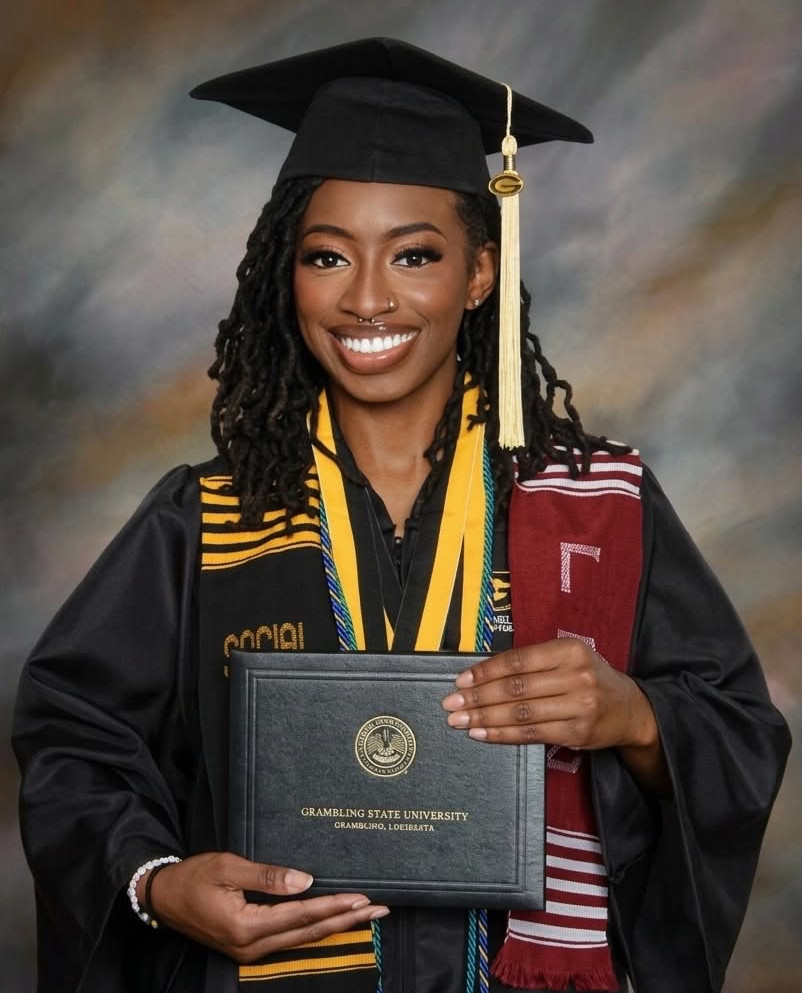
There is a particular kind of disappointment that comes with realizing your life is not unfolding the way you imagined. Maybe you pictured yourself graduating from a four-year university, walking across the stage in the school colors you once proudly wore, or finally becoming the person you told everyone you would be. Then, somewhere along the way, things change. The classes become harder to navigate, the excitement begins to fade, and you find yourself questioning whether you belong in the very place you worked so hard to reach.
For some students, the hardest part is not figuring out what comes next. It is forgiving themselves for how the journey started.
Adanna Ogbogu knows what that feels like.
Before earning her Associate in Arts for Transfer in Sociology from Chaffey College and eventually graduating from Grambling State University with a Bachelor of Social Work, Adanna had to confront a version of her college experience that did not look anything like she had hoped. Leaving her first four-year university brought uncertainty, disappointment, and the weight of wondering what her decision meant for her future.
But what if leaving was not the end of her story? What if it was the beginning of finding her way back to herself?
Learning to Stop Measuring Herself by Where She Left
When Adanna began reconsidering her educational path, she was not simply looking for another college to attend. She was looking for direction, support, and an opportunity to understand what she truly wanted from her future.
After her aunt suggested Chaffey College, Adanna began researching what the institution could offer. She discovered its Extended Opportunity Programs and Services (EOPS) program, which would provide additional support as she continued her education.
Looking back, she described her decision as one that came after realizing she needed something different.
“I felt it was the best decision to make after dropping out of my original university because I was misguided and didn’t really know what I wanted or what inspired me. Community college would give me direction.”
There is something deeply relatable about that realization. Sometimes, we make decisions before we fully understand ourselves. Sometimes, we choose a path because it seems like the next logical step, because everyone around us is moving in that direction, or because we believe there is only one way for our lives to look successful.
And when that path does not work out, it can be difficult to separate the experience from our identity.
Adanna had to do exactly that.
“I had to stop beating myself up for leaving a 4-year and failing courses while there,” she shared.
Those words carry a weight that a transcript could never communicate. A transcript might show the courses a student failed or the institution they left, but it cannot tell you how long they spent questioning themselves afterward. It cannot measure the courage it takes to try again when you are afraid that your previous experience says something about your ability to succeed.
For Adanna, moving forward meant no longer allowing her first university experience to determine what she believed was possible for her.
And part of that healing came from understanding that her struggles were not happening in a vacuum.
Sometimes, It’s Not That You Don’t Belong in College
When students struggle in college, the conversation often turns toward what they need to do differently. They are told to manage their time, study harder, ask for help, or become more involved. While those things can be important, Adanna’s experience raises another question: What happens when the environment itself makes it difficult for a student to feel seen, supported, or safe?
Reflecting on her first university, she explained that she struggled with what she described as “Imposter Syndrome.” She also recognized the absence of spaces that could have helped her feel more connected to the campus community.
“I overcame a lot of ‘Imposter Syndrome’ but I also didn’t feel safe or considered in that university because there was no BSU, women, or multicultural centers.”
For students who have ever walked across a campus and wondered whether there was a place for them, this part of Adanna’s story may feel familiar. You can be enrolled at an institution, attend your classes, and work toward a degree while still feeling disconnected from the environment around you. You can be capable of doing the work and still struggle to find a community where you feel understood.
Belonging is not always something students can create on their own. The spaces institutions cultivate, the relationships they encourage, and the support they make accessible can shape how students experience higher education.
Adanna came to understand that struggling at one university did not mean she had to give up on higher education altogether.
“I knew higher education was for me but not every collegiate environment cultivates or provides a safe place for you to thrive. That is much more important than many would realize.”
That distinction matters. There is a difference between deciding college is not for you and recognizing that the environment you are in may not be where you can thrive. Sometimes, finding your place means giving yourself permission to explore somewhere else.
For Adanna, that place began to take shape at Chaffey College.
Finding More Than a Degree at Chaffey
Between June 2021 and June 2023, Adanna’s experience at Chaffey became about more than completing assignments and earning credits. She began building relationships, becoming involved in clubs, and connecting with faculty members who eventually became like family.
The difference was not simply that she had found another institution. She was beginning to find a sense of community and a clearer vision for herself.
“After two years at Chaffey, I gained a lot of wisdom, purpose, vision, and direction,” she reflected.
She continued, “Through building relationships in all my affiliated clubs, faculty (that turned into family), and truly immersing myself in the community I’ve grown up around for years, I was ready to walk the stage.”
On May 18, 2023, Adanna graduated with her associate degree in Sociology.
For someone who had once questioned her direction after leaving a four-year university, that moment represented a meaningful shift. She had given herself the opportunity to start again, and in doing so, she discovered that her educational journey still had somewhere to take her.
But she was not ready to stop there.
Sometimes, finding your footing does more than restore your confidence. It allows you to imagine a future that once felt too far away to consider.
For Adanna, that future was taking her to an HBCU.
The Decision to Leave Home and Bet on Herself
The idea of attending a Historically Black College or University became part of Adanna’s next chapter. In January 2023, she decided she wanted to attend an HBCU, and two weeks after graduating from Chaffey, she had an opportunity to tour schools through Umoja.
The tour took her from the South to the East, introducing her to institutions beyond the California environment she had known. But deciding to transfer was only the beginning. There were applications to complete, people to contact, and decisions to make before the plan could become a reality.
“After a long summer of checking, applying, communicating, and cold-calling, I was registered and ready to transfer to Grambling State University!”
Her decision meant leaving California for Louisiana and stepping into an unfamiliar environment. She was moving beyond the community she knew and choosing an experience that would challenge her to grow in new ways.
It is easy to celebrate a decision once we know how the story ends. It is harder to make that decision when the outcome is still uncertain, when family members may have concerns, when you have to figure out how everything will work, and when you are the one responsible for taking the leap.
Adanna chose to keep going.
On May 15, 2026, she graduated from Grambling State University with her Bachelor of Social Work. She also shared that she is now a licensed and registered social worker in Louisiana.
The student who once had to work through the disappointment of leaving a four-year university had continued her education, crossed state lines, earned another degree, and moved into the next stage of her professional journey.
Her story is not about proving that every setback will lead to an extraordinary outcome. It is about what can become possible when a setback does not get to make the final decision about your future.
“Please See It Through for Yourself”
When Adanna talks about education, her advice is not limited to the classroom. It is something she has shared at college conferences, workshops, and with her own cousins and siblings.
“You have to take opportunities when they’re presented to you.”
It is a simple message, but living it out can require difficult choices. Pursuing an opportunity might mean leaving home, starting over, entering an unfamiliar environment, or accepting that the path ahead will not always be comfortable.
Adanna knows that firsthand.
“The transition from California to Louisiana was not easy. You may miss the little things about home, but education is a journey you choose to see through.”
There is a difference between hearing someone tell you to keep going and hearing it from someone who has had to make difficult decisions about her own journey. Adanna’s encouragement comes from experiencing the uncertainty, taking the opportunities available to her, and continuing even when the next step meant leaving what was familiar.
Her final message is one that reaches beyond students transferring from community college or considering an HBCU. It is for anyone who has ever felt behind, questioned a decision, or wondered whether an unexpected beginning has already limited what they can become.
“Please see it through for yourself. You’ll learn sooo much about yourself and learn how much more you’re capable of.”
Perhaps that is what makes Adanna’s story worth telling. Her journey reminds us that you do not have to have everything figured out at the beginning. You can change direction. You can discover that one environment is not right for you. You can take longer than you planned, find support somewhere unexpected, and still build a future you are proud of.
Leaving her first university did not mean she had reached the end of her potential. It meant she had an opportunity to reconsider what she needed, what inspired her, and where she wanted to go.
At Chaffey, she found direction. At Grambling State, she continued building on it. And through her journey, she offers a reminder to students who may be navigating their own uncertainty: your first attempt does not have to be your final chapter.
You are allowed to find a different way forward.
And sometimes, the most important decision you make is giving yourself permission to keep going.
This is Rising Voices — where the stories behind the journey matter just as much as the destination.